Healthcare is undergoing one of the most profound transformations in its history. The challenges are unmistakable—rising costs, aging populations, chronic diseases, fragmented delivery systems, workforce shortages, and increasingly demanding patient expectations. Meanwhile, new technologies, from AI-driven diagnostics to remote monitoring and digital engagement, are reshaping how care is delivered, accessed, and experienced.
Yet even with all this innovation, the global healthcare landscape remains deeply fragmented.
- Systems don’t talk to each other.
- Workflows are inconsistent.
- Providers operate in silos.
- Patients navigate a maze of disconnected touchpoints.
To genuinely modernize healthcare, we must stop viewing individual systems and start seeing the entire healthcare ecosystem dynamic, interconnected network of people, processes, data, and technologies working toward one shared goal: delivering safe, efficient, and patient-centered care at scale.
In this blog, I explore the big picture of the healthcare ecosystem and introduce a modern reference solution architecture that organizations can use as a blueprint for digital transformation.
Understanding the Modern Healthcare Ecosystem
A complete healthcare ecosystem brings together multiple stakeholders, each with unique roles, expectations, and dependencies. When digitally connected, they collectively shape a continuous care experience.
They sit at the center of the ecosystem. Modern patients expect access, transparency, personalization, remote care, and seamless digital experiences across apps, portals, and telehealth platforms.
- Providers (Hospitals, Clinics, Doctors, Labs)
As the core of service delivery, providers depend on EHRs, diagnostics, scheduling, clinical workflows, and decision support systems to deliver efficient, high-quality care.
The financial engine of the ecosystem. Their operations rely on claims processing, fraud detection, utilization reviews, coverage management, and population-level insights.
- Pharma, MedTech & Life Sciences
From R&D to clinical trials to distribution, these players require robust supply chains, regulatory compliance, real-world evidence, and post-market surveillance.
- Public Health Agencies & Regulators
They establish policies, monitor population health, ensure safety, and rely on accurate, interoperable data for reporting and surveillance.
- Technology Platforms & Vendors
They provide the digital backbone—cloud, cybersecurity, interoperability frameworks, AI, data lakes, and integration engines that enable connected care.
A truly modern healthcare ecosystem connects all these actors through unified, interoperable digital infrastructure.
Why Healthcare Needs Unified Digital Architecture
Traditional healthcare IT was designed for an era when information lived inside a single facility. But today’s expectations have changed:
- Patients expect digital-first healthcare.
- Clinicians expect integrated workflows and real-time decision support.
- Payers expect data accuracy and automation.
- Governments expect standardized reporting and surveillance.
- Researchers expect access to real-world evidence.
- Administrators expect cost efficiency and operational clarity.
To meet these expectations, healthcare needs a modular, scalable digital architecture that enables interoperability, intelligence, and automation across the ecosystem.
This is where a reference healthcare solution architecture becomes essential.
A Modern Reference Solution Architecture for Healthcare
After years of working with digital platforms across industries, I’ve seen the architectures that scale—and the ones that struggle. A successful healthcare platform must be rooted in openness, interoperability, security, and scalability.
Think of it as a Healthcare Operating System: a unified platform where every service, system, and stakeholder can seamlessly connect.
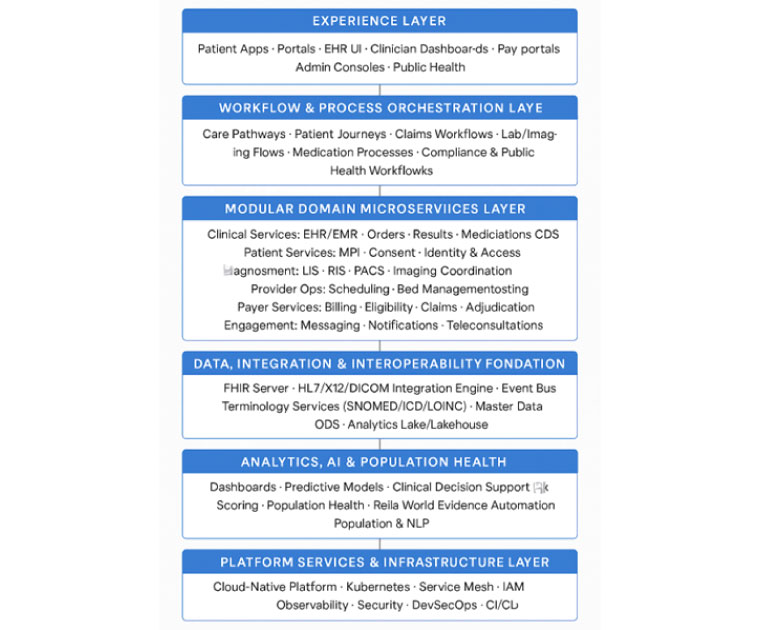
1. Experience Layer — Where Healthcare Happens
This layer powers the applications that patients, clinicians, and administrators use daily:
- Patient apps & portals
- Clinician dashboards & EHR front ends
- Operational consoles
- Payer & provider portals
- Public health reporting dashboards
APIs ensure a unified, consistent experience across all touchpoints.
2. Workflow & Process Management — The Heartbeat of the Ecosystem
Healthcare is complex. A workflow engine ensures processes are consistent, automated, and compliant:
- Patient journeys & care pathways
- Claims workflows
- Lab & imaging processes
- Medication administration
- Compliance & public health workflows
This eliminates manual effort and reduces variability.
3. Modular Domain Microservices — The Building Blocks of Digital Healthcare
A composable set of independent, reusable microservices shape the ecosystem:
- Clinical Services - EHR/EMR, orders & results, medication management, care plans, CDS.
- Patient & Identity Services - Master patient index, consent management, access control.
- Diagnostics & Imaging - LIS/RIS/PACS, imaging workflows, lab results processing.
- Provider Operations - Scheduling, bed management, rosters, resource optimization.
- Financial & Payer Services - Billing, eligibility, claims, adjudication, fraud checks.
- Supply Chain & Pharmacy - Inventory, procurement, dispensing, stock intelligence.
- Communication & Engagement - Secure messaging, reminders, notifications, teleconsultations.
This modular approach ensures scalability, configurability, and rapid innovation.
4. Data, Integration & Interoperability Layer — The Nervous System
A connected healthcare ecosystem requires frictionless, standardized data flow:
- FHIR server for clinical interoperability
- Integration engine for HL7, X12, DICOM
- Event bus / streaming layer for real-time updates
- Terminology services (SNOMED, ICD, LOINC)
- Operational Data Store (ODS)
- Analytics lake / lakehouse for structured and unstructured data
This enables real-time, accurate, interoperable data exchange across all systems.
5. Analytics, AI & Population Health — Intelligence Everywhere
With the right architecture, healthcare can finally move from reactive to proactive:
- Clinical & operational dashboards
- Predictive analytics (readmissions, LOS, demand forecasting)
- Automated coding & documentation
- Population health insights
- Real-world evidence for regulators & pharma
AI becomes a force multiplier—reducing administrative burden and elevating clinical decision-making.
6. Platform Services & Infrastructure — The Foundation
A modern digital ecosystem requires enterprise-grade reliability:
- Cloud-native microservices on Kubernetes
- Secure service mesh
- Observability: logs, metrics, tracing
- IAM, secrets Management.
- Automated backups & disaster recovery
- DevSecOps, CI/CD pipelines
This ensures security, compliance, and high availability.
Why This Architecture Matters: The Value It Unlocks
A unified digital architecture unlocks transformational value across the ecosystem:
✔ Seamless Patient Journeys - From appointment to discharge to home monitoring.
✔ Integrated Clinical Workflows - No more toggling across disconnected systems.
✔ Operational Efficiency - Reduced delays, optimized resources, automated routing.
✔ Financial Accuracy - Cleaner claims, fewer denials, better reimbursement cycles.
✔ Data-Driven Decisions - Analytics and AI powering smarter choices.
✔ Faster Innovation - Plug-and-play integration for new devices, apps, and AI tools.
✔ Regulatory Compliance - Built-in consent, auditing, and data governance.
This is the foundation of 21st-century healthcare.
The Role of a Reliable Engineering Partner
Healthcare organizations increasingly rely on engineering partners who bring both domain expertise and deep technical capability to:
- Build digital health platforms
- Modernize legacy systems
- Implement interoperable architecture
- Develop cloud-native solutions
- Integrate medical devices & IoT monitoring
- Enable AI/ML layers
- Ensure privacy, security, and compliance
The combination of engineering excellence + healthcare domain understanding is what turns strategic vision into practical, future-ready digital platforms.
Conclusion: The Future of Healthcare Is a Connected Ecosystem
Healthcare is evolving into an interconnected network powered by digital platforms, real-time data, and intelligent workflows. A modern reference architecture is no longer optional—it is a strategic necessity.
Organizations that embrace this approach will deliver:
- Better patient outcomes
- Higher operational efficiency
- Stronger financial performance
- A seamless, human-centered experience
The transformation is already underway.
The building blocks for a modern healthcare ecosystem are here.
Now is the time to bring them together.