The GCC ecosystem is booming—and with it, so is the buzz.
Everywhere we look, companies are announcing new Global Capability Centers. New service providers are springing up. New leaders are offering “plug-and-play” models. And a flood of frameworks promises to help organizations “set up and scale” in record time.
It reminds us of the feelings of a gold rush!
But every instance comes with a familiar pattern: the louder the noise, the harder it becomes to identify the real value. And in the GCC world, this is becoming a serious risk—because a GCC is not a project you launch. It is a model you build, refine, and sustain for years.
So, if you’re considering a GCC in 2026 and beyond, here is the most important truth to internalize:
A GCC Is not a “Setup Project.” It’s a Long-Term Operating Model.
When organizations talk about GCCs, they often begin with a “setup” mindset:
- Find a location
- Hire talent
- Build a delivery pipeline
- Start work
- Scale quickly
That mindset isn’t wrong, it’s simply incomplete.
Because the most successful GCCs weren’t built overnight. They became successful because they were built with:
1) Intent
A GCC needs clarity: Why do we want this? Is the goal operational efficiency? Capability expansion? Speed to market? Innovation? Product ownership?
Without intent, a GCC becomes a “catch-all” center that tries to do everything—and eventually struggles to do anything meaningfully well.
2) Purpose
Intent becomes powerful only when translated into purpose. Purpose is what guides decision-making—especially during uncertainty.
A GCC that exists for “cost” alone rarely earns deep trust or strategic relevance. But a GCC built around purpose—customer outcomes, engineering acceleration, platform modernization, faster innovation cycles—builds credibility quickly.
3) Patience
Here’s the uncomfortable part: high-performing GCCs take time.
They mature through learning curves, leadership transitions, operational resets, and talent market shifts. Many early-stage GCC decisions feel “slow” because you’re building foundations.
Yet, the GCCs that endure are the ones that resist shortcuts.
4) Operational Rigor
Great GCCs win not because of flashy ideas—but because of boring excellence:
- Predictable delivery
- Measurable outcomes
- Process consistency
- Governance discipline
- Stakeholder management
That discipline becomes the difference between a center that scales sustainably and a center that collapses under its own growth.
5) Leadership Continuity
GCCs don’t fail because the model doesn’t work. They fail because of sponsorship changes, priorities shift, and leadership resets happen without continuity.
The GCCs that become indispensable survive leadership transitions because they build:
- Depth in leadership bench
- A shared long-term roadmap
- Strong governance
- Cultural alignment with the global organization
How the Best GCCs Earn a Seat at the Strategy Table
The most impactful GCCs didn’t “get lucky.” They evolved.
They began as execution engines. Then it grew into capability hubs. Then matured into strategic capability engines that influence product direction, innovation, and business outcomes.
They stayed relevant through:
- Technology shifts (cloud, AI, platform engineering)
- Business model transformations
- Organizational restructuring
- Market volatility
They earned their place not because they were “cheap,” but because they were indispensable.
Which brings us to the maturity journey.
The GCC Maturity Journey: Why “One Size Fits All” Fails
One of the biggest myths in the GCC space is that scaling is just about hiring faster and expanding work.
GCCs evolve through distinct maturity stages, and each stage requires different building blocks.
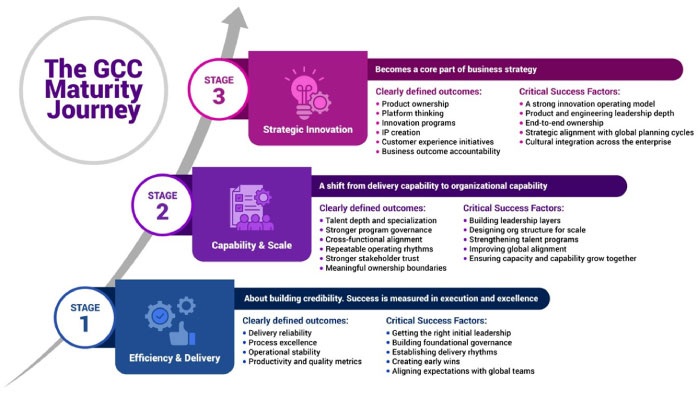
Stage 1: Efficiency & Delivery
Early stage GCCs typically begin with clearly defined outcomes:
- Delivery reliability
- Process excellence
- Operational stability
- Productivity and quality metrics
This stage is about building credibility. Success is measured in execution and excellence.
What matters most here:
- Getting the right initial leadership
- Building Foundational governance
- Establishing delivery rhythms
- Creating early wins
- Aligning expectations with global teams
Many GCCs stumble here because they attempt to scale before they stabilize.
Stage 2: Capability & Scale
Once operational stability is established, the GCC enters the scaling phase.
This stage is not “more of the same.” It’s a shift from delivery capability to organizational capability:
- Talent depth and specialization
- Stronger program governance
- Cross-functional alignment
- Repeatable operating rhythms
- Stronger stakeholder trust
- Meaningful ownership boundaries
What matters most here:
- Building leadership layers
- Designing org structure for scale
- Strengthening talent programs
- Improving global alignment
- Ensuring capacity and capability grow together
Many GCCs stall at this stage because the center grows faster than the operating model.
Stage 3: Strategic Innovation
At maturity, a GCC moves beyond “support.” It becomes a core part of business strategy.
This is where you see:
- Product ownership
- Platform thinking
- Innovation programs
- IP creation
- Customer experience initiatives
- Business outcome accountability
What matters most here:
- A strong Innovation operating model
- Product and engineering leadership depth
- End-to-end ownership
- Strategic alignment with global planning cycles
- Cultural integration across the enterprise
This stage cannot be reached by hiring alone. It requires trust, autonomy, and sustained governance maturity.
Why GCCs Stall (Even When the Model Is Proven)
Most GCCs don’t stall because the concept is flawed. They stall because maturity was not designed from day one.
Common causes include:
- No clear long-term strategy
- Weak leadership alignment between HQ and GCC
- Unclear ownership boundaries
- Governance that doesn’t scale
- Cultural disconnect
- Partner models optimized for speed, not sustainability
In short: the operating model was not built with a maturity roadmap in mind.
What Separates Real GCC Builders from the Noise
If you’re evaluating partners, frameworks, or internal leadership for a GCC journey, here’s a simple rule:
Ignore marketing promises. Look for fundamentals.
Sustainable GCC outcomes come from boring things done exceptionally well.
Here are the signals of “real music.”
1) A Clear Maturity model
A credible GCC builder can articulate:
- How a GCC evolves across maturity stages
- What changes in governance, leadership, org structure, and outcomes
- What “success” looks like at each stage
If someone cannot explain maturity progression, they are probably selling a setup checklist—not a long-term model.
2) Governance that scales
Governance is not a monthly meeting. It is a system of clarity:
- Decision rights
- Accountability models
- Escalation paths
- Operating cadence
- Stakeholder alignment mechanisms
Governance must evolve as the GCC scales. What works at 50 people will fail at 500.
3) Succession planning
High-performing GCCs are not dependent on one champion.
They invest in leadership depth early:
- Leadership bench strength
- Future-ready succession paths
- Continuity mechanisms that survive transitions
A GCC without leadership continuity is always one reorg away from collapse.
4) Cultural integration
A GCC succeeds when it feels like a true extension of the parent organization—not a remote execution unit.
Culture shows up in:
- Ways of working
- Trust and collaboration
- Decision autonomy
- Shared standards and principles
- Stakeholder relationships
Cultural integration is not “nice to have.” It’s a growth enabler.
5) Operating realism
Great GCC builders understand the nuanced reality of corporate environments:
- Shifting priorities
- Leadership changes
- Enterprise compliance and security constraints
- Talent market volatility
- Change management complexity
- Competing internal stakeholders
The best builders don’t sell perfection. They build resilience.
The GCC Opportunity Is Real—But Only If We Build It Right
The GCC model has proven its value for decades. And now adoption is accelerating across industries and company sizes.
That momentum is exciting.
But with growth comes responsibility: the next wave of GCCs must be built with the same rigor and long-term thinking that made the best ones endure.
As 2026 unfolds, the question isn’t: “Who can set up a GCC fastest?”
It’s:
“Who can build one that lasts—and becomes indispensable?”