In today’s competitive market, many businesses focus solely on the customer, often forgetting the people who make those customer experiences possible, the employees. A recent collaboration between a major retail company and Gadgeon has proven that a "people-first" approach is the most effective way to drive a digital transformation. By focusing on making employees happy through better technology, the company was able to achieve significant growth and customer satisfaction.
The Challenges of Legacy Systems
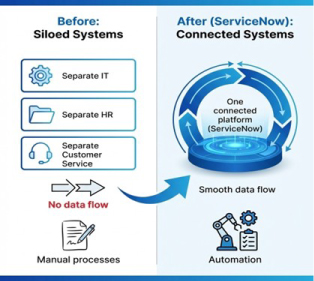
Before this transformation, the company faced several major hurdles. Their IT, HR, and customer service processes were inefficient and slowed down daily operations. They were stuck using saturated legacy systems that could no longer keep up with modern demands.
These outdated systems created "innovation gaps," particularly in how they cared for their customers. Without the right tools, it was difficult for the company to compete in a crowded market or strengthen its brand presence. They needed a way to streamline operations, reduce costs, and embrace the latest technologies across the entire organization.
A Strategic ServiceNow Roadmap
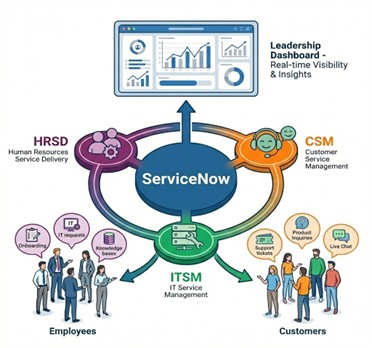
To fix these issues, the company partnered with Gadgeon to implement the ServiceNow Product Suite. Rather than deploying multiple tools at once, the company followed a phased approach. They began with ITSM to stabilize core operations and gain visibility into recurring issues. This clarity revealed that many service delays were rooted not only in IT, but also in HR processes and employee enablement. As a result, HR Service Delivery (HRSD) was introduced to improve internal efficiency and employee experience. Once these foundations were in place, the company extended the same service model to customers through Customer Service Management (CSM), creating a connected, end-to-end service experience.
Empowering Employees with HRSD
The philosophy was simple: a transformative journey starts by making employees happy. By implementing HRSD, the company focused on making the "work-life" of its staff easier.
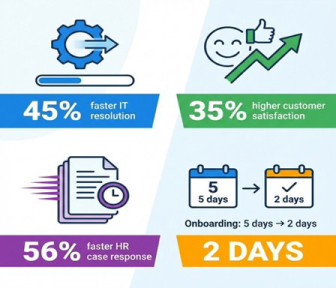
The results were immediate and impressive. The time it took for the HR team to respond to cases was reduced by 56%. Perhaps most importantly, the onboarding process for new hires was slashed from 5 days down to just 2 days. When new employees can get to work faster and feel supported by efficient HR systems, their overall job satisfaction increases.
Modernizing IT Operations (ITSM)
A frustrated employee is often one whose computer or software isn't working. By using ServiceNow ITSM, the company aimed to improve operational efficiency and reduce the time wasted on technical glitches.
Through automation and better process management, the company saw a 45% faster incident resolution rate. Additionally, they experienced 39% fewer repeated incidents, meaning that when a problem was fixed, it stayed fixed. This reliability allows the team to focus on innovation rather than constantly putting out "technical fires".
Driving Customer Excellence (CSM)
The final piece of the puzzle was the customer. The company introduced a new customer portal designed to mitigate issues and drive business growth. By connecting the back-end efficiency of IT and HR to the front-end customer service, the impact was clear.
The company reported a 35% improvement in Customer Satisfaction (CSAT) scores. Furthermore, there was a 25% reduction in service escalations, indicating that more customers were receiving what they needed the first time they requested it.
Visibility and Accountability
One of the most significant "behind-the-scenes" wins was the implementation of unified dashboards. In the past, data was likely scattered across different legacy systems. Now, management has clear visibility into how every department is performing. This transparency has improved accountability and allows the leadership team to make decisions based on real-time data rather than guesswork.
Final Thoughts: A Model for Modern Retail
The partnership between this retail company and Gadgeon shows that digital transformation is about more than just "buying new tech." It is about a strategic approach to innovation that links employee happiness directly to customer success. By replacing slow, legacy systems with automated, integrated solutions, the company has not only improved its productivity but has also built a stronger, more competitive brand.
FAQs
1. Why did the company take a people-first approach to transformation?
The company recognized that employee experience directly impacts customer experience. By first improving how employees interacted with IT and HR systems, the organization reduced friction in daily work. This allowed employees to respond faster and more consistently to customer needs, ultimately improving customer satisfaction.
2. Why was a phased implementation chosen instead of deploying everything at once?
A phased approach allowed the company to stabilize core operations before expanding transformation efforts. Starting with ITSM ensured operational reliability, followed by HRSD to improve employee productivity, and finally CSM to enhance customer interactions. This reduced risk and helped provide better adoption across teams.
3. How did Gadgeon support the retail company throughout the transformation?
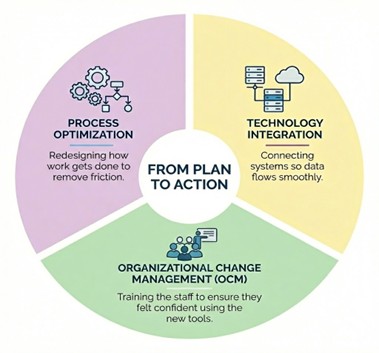
Gadgeon worked closely with the retail company from planning through execution. The engagement began with strategy and innovation workshops to understand operational challenges, followed by a phased implementation of ServiceNow across IT, HR, and customer service. Gadgeon also supported process optimization and organizational change management to ensure teams could adopt the new systems effectively and sustain the improvements over time.
4. What’s next for the company after this ServiceNow transformation?
With a strong ServiceNow foundation in place, the next phase focuses on AI-led optimization and automation. The company can now leverage AI to proactively predict incidents, automate case routing, and accelerate resolutions across IT, HR, and customer service. By adopting AI-driven insights and Agentic AI capabilities, routine tasks can be handled autonomously, enabling teams to focus on strategic initiatives, continuous improvement, and delivering even better employee and customer experiences.