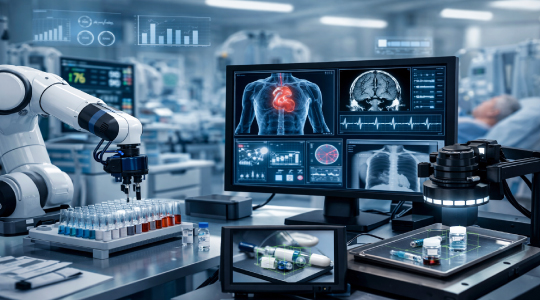
Medical device design and medical device engineering are twofold interconnected disciplines within the sphere of healthcare technologies. Both with their own distinct importance play a crucial role in guaranteeing that the products always meet diverse clinical needs while addressing quality standards in terms of safety, efficacy, and regulatory compliance.
Core aspects of medical device design
Medical device design is essentially about shaping the overall user experience, technical feasibility, and the feature set of a specific medical product from its basic conceptualization. The process starts by recognizing formerly unmet clinical requirements by interacting with the end users, like healthcare professionals, administrators, and patients.
These unmet clinical requirements help the medical device design professionals to finalize a list of features for future products. Typically, the medical device designing phase includes developing the future product idea and concept, doing usability studies, and conducting feasibility studies. Finally, prototyping of the medical device is done. The other critical constituent during the design stage is risk management. This supports the design team to anticipate possible health risks and resolve them throughout the lifecycle of the device.
Fundamental truths about medical device engineering
Medical device engineering helps to transform the original design concepts and essential requirements into effective, real-life solutions by working with engineering principles and multidisciplinary collaborative efforts. This form of engineering brings together countless mechanical, biomedical, electrical, and software engineering elements.
The engineering teams can iteratively develop, assess, and enhance the devices, thus making sure that they can comply with strict international regulations like FDA, ISO 13485, and IEC 62304, and endure practical usage. This helps to select materials, work on design subsystems, create the prototypes, and resolve reliability and manufacturability issues that are vital in healthcare technologies. For instance, software engineers may set up control algorithms for infusion pumps, and mechanical engineers can optimize the housing stability and ergonomic aspects.
Relationship between medical device design and medical device engineering
Medical device design and medical device engineering are closely related fields that complement each other in several ways:
- Design creates the blueprint of the new product, summarizing the technical, clinical, and end-user insights.
- Engineering allows implementing these blueprints to create practical, testable, and workable medical solutions.
Essential differences with data points
Medical device design and medical device engineering differ from each other in terms of their scope and approach. Medical device design focuses mainly on ideation, defining the requirements, thorough risk analysis, and creating a functional layout. The discipline is mainly iterative, collaborative, and user-centric, and is usually captured using design control documentation as needed by the regulators.
Medical device engineering deals with following the scientific and systematic process of implementation of physical, mathematical, and software principles for manufacturing, assembling, and validating the medical devices. Medical device engineering is concerned with ensuring reliability, technical robustness, and scalability of the device products. Bench validation, clinal simulations, stress testing, and other tests for evaluating performance effectiveness are done by engineering.
As mentioned earlier, medical device engineering and medical device design are complementary areas. While medical device design provides the concept of the new device, medical device engineering helps to make the concept a real-world device. These two disciplines are crucial for developing innovative medical device products that are safe and reliable.